
In Part One, I wrote about the phone as a useful tool. In Part Two, I wrote about the feed that holds our attention and does not let us go.
This is where that thinking led me next.
There comes a moment when I know I need a break. I have done enough thinking for now. My body wants to move and stretch. My eyes want distance from the screen. Perhaps I need to close them and sleep for ten minutes.
And instead, I start scrolling.
A surprising number of minutes fly by and I haven’t rested. I’ve filled the space that might have been restful with more input. Why do I do this? Maybe it’s because scrolling lets me stop what I’m doing without fully stopping. It offers relief, entertainment, company or escape without asking me to change course. Rest asks more of me. I have to recognize that I’m tired, and then I need to switch gears, put something down, and give myself permission to unplug for a little while. A nap has to be chosen. The feed does not.
Perhaps you know this kind of not-resting too: your body asked for less, and somehow you gave it more.
Knowing what we need and actually giving ourselves what we need are two different things.
Knowing asks us to pay attention. Responding asks us to take what we notice seriously enough to change what we do next. Sometimes that means stepping outside. Sometimes it means contacting one person. Sometimes it means putting the phone down and finally taking the nap.
What are we actually reaching for?
I enjoy Reels. They make me laugh. I learn things. I find ideas, people and places I would not otherwise encounter. Sometimes that’s exactly what I want.
But sometimes the hand reaching for the phone is carrying another need entirely.
Maybe I need relief, company, beauty, stimulation, inspiration or escape. Maybe I am tired enough to need a nap but not quite willing to stop. Maybe I want a break without having to make a decision about what would actually feel restorative.
The feed is easy at the point of entry. It asks almost nothing of me. One short moment appears and then another. A story. A face. A recipe. A cat or a dog. A beautiful place. A good idea. Swipe up. Begin again.
There is no moral failure in reaching for it. Scrolling may be an attempt to care for ourselves with what’s immediately available to us.
The more useful question takes a little courage: Is this really what I need, is it giving me what I am reaching for?
Another kind of feed
Sometimes the honest answer is yes, and I keep scrolling without regret.
Sometimes it is no. And when it is, I have found there is another feed I can turn to. It is not as easy to reach. But when what I am reaching for is air, movement, silence or my own thoughts, it is often closer to the thing itself.

When I step outside, there is always something else to notice.
A bird lands on a branch. Light moves through the trees. Grass leans in the wind. My shoes crunch over gravel. I hear my own breath, and then a sound I cannot immediately identify.
One small living moment leads to another.
It is almost like scrolling. No really, it is.
Except I am not swiping. My attention is.
Nature offers a stream of movement, colour, texture, sound, scent, temperature and change. But it happens at a different pace. Nothing requires me to leave one moment before I have finished with it. I can participate. I can choose to notice.
I can follow the bird, turn toward the sound, look more closely at a leaf or remain with the same patch of light until it changes.
I can move on, but I do not have to.
Outside, not every moment arrives trying to hold my focus. There are unfilled stretches. Nothing happens for a while. A digital feed is built to erase exactly that pause. But the pause is often when a bird lands or when my own thoughts catch up with me: a feeling I had not registered, a question I had set aside. Had I swiped, I might have missed both.
On a digital feed, the next thing arrives automatically. Outside, my attention participates in finding it.
And because my whole body is present, I am not only watching. I am listening, breathing, balancing and moving through the scene. I am not consuming nature as content. I am participating in a living place.
The strength to respond
You may know exactly what would help and still feel the resistance of changing course.
Giving ourselves what we need often involves a transition.
We have to put down the phone, stand up, perhaps put on shoes, step away from the task or tell someone we are unavailable for a little while. If what we need is sleep, we have to give ourselves permission to stop. If we need quiet, we may have to disappoint the part of us that believes we should remain productive or reachable.
That can be particularly difficult when we have spent years orienting ourselves toward what everyone else needs.
Nature cannot make the decision for me. The feed outside does not arrive beneath my thumb. I have to get up and meet it.
But once I do, it gives my attention room to choose again.

And the response can be small. If I need nature, I may not need a long walk. I may need to step outside and look at the sky. If I need rest, I can put the phone face down and close my eyes for ten minutes. If I need company, I can message one person instead of taking in the lives of dozens.
A need does not have to become an emergency before it deserves a response. Each time we offer ourselves even a small one, we practise a kind of self-trust: I can hear myself, and I can do something with what I hear.
Attention can feel different outside
Researchers have a name for one way natural environments may hold our attention: soft fascination.
Much of daily life requires directed attention. We concentrate, choose, filter distractions and bring our minds back to the task. That effort can become tiring. Natural movement can engage us without asking for the same kind of effort: a cloud changing shape, water rippling, leaves shifting in the wind.
A systematic review of attention-restoration research found small-to-moderate improvements in working memory and cognitive flexibility after nature exposure, with less reliable evidence for attentional control. Nature is not a guaranteed reset button. Still, the research supports something many of us recognize: not all attention feels the same.
The feed outside still catches my attention. It simply catches it differently.
It also matters how I meet it. Being physically outside is not always the same as connecting with what is there.
Research on actively noticing nature points in the same direction. In one study, noting three good things in nature each day for five days increased participants’ sense of nature connection, with the difference still present two months later. Later research found that watching, listening to and photographing wildlife predicted nature connection beyond simply spending time outdoors. The quality of our attention matters, not only our location.
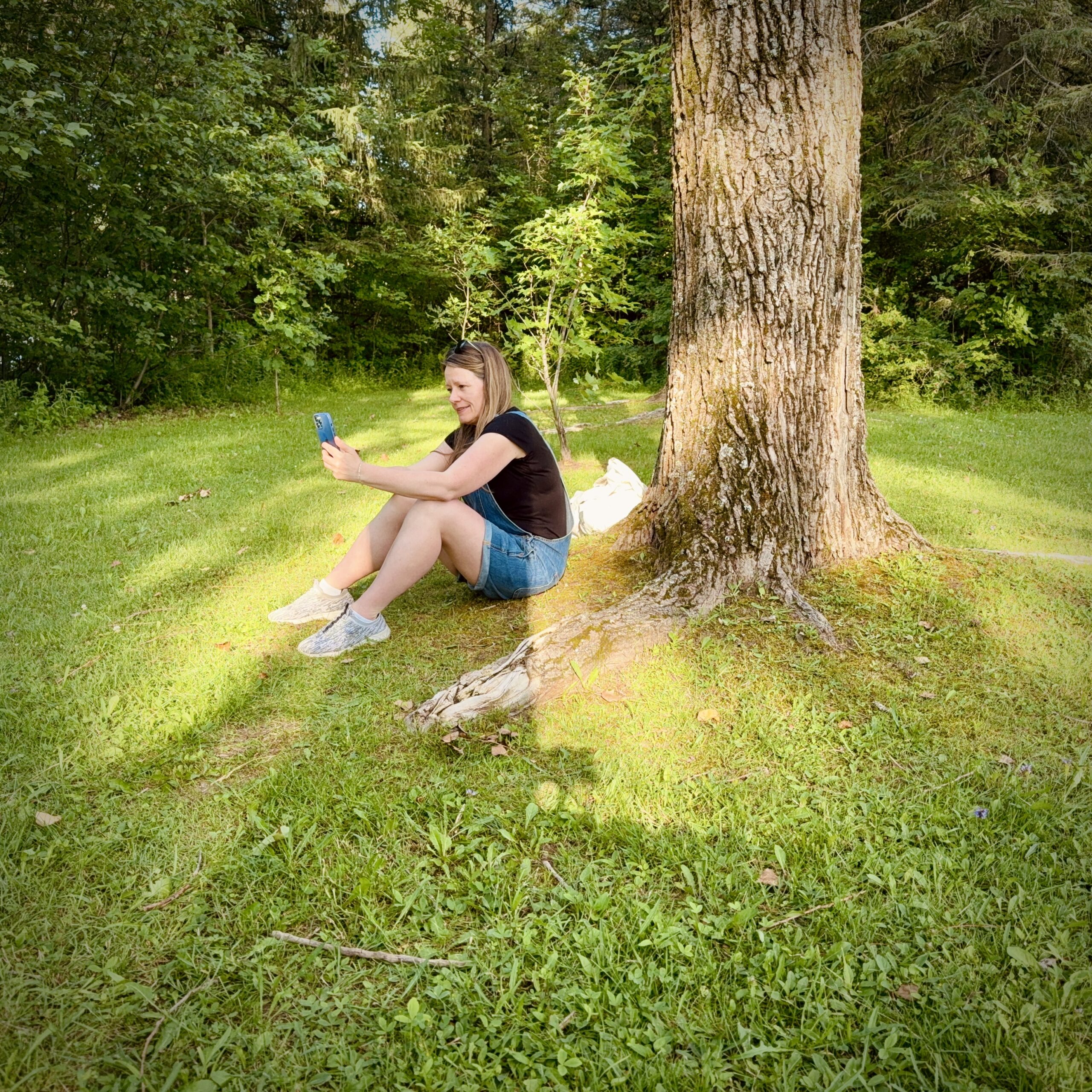
That is one reason I resist the idea that nature connection requires leaving my phone behind. My camera helps me notice. I look more closely at the curve of a petal, the architecture of a seed head or the way light gathers at the edge of a leaf. The photograph keeps me looking long enough to see more.

The same device can also carry my attention somewhere else entirely. In one experiment, using a laptop during a green-space break substantially reduced the attentional benefit of the setting.
The question is not simply whether my phone is in my hand. It is whether it is connecting me with the place where I am standing or continually pulling me away from it.
Before you open the feed
The next time you reach for your phone, pause for a moment. Not to stop yourself. Just long enough to ask:
What am I hoping to feel?
Am I looking for laughter? Company? Beauty? Relief? Stimulation? Rest?
Then ask:
Is this likely to give me what I need right now?
Sometimes the answer will be yes. Watch the Reels. Send the message. Enjoy it.
Sometimes you may realize that no amount of scrolling will become the nap you need. It will not become movement, quiet, fresh air or a conversation with someone you love.
If what you need is a different kind of break, try stepping outside for ten minutes. You can bring your phone.
Begin with whatever catches your attention first. It might be movement, colour, sound or the feeling of air against your face. Stay until something else naturally draws you onward.
Let one living moment lead to the next:
- A bee.
- Light through the trees.
- Caterpillars munching.
- Breath stopping colour.
- The rhythm of your breath.
- A detail you nearly passed without seeing.
If you take a photograph, pause before and after you press the button. Let the camera help you enter the moment before you decide whether the moment needs to be shared.
There is nothing to accomplish. Simply notice what holds your attention and how you feel when you return.
I am not giving up Reels. I want to notice the moment my hand reaches for them and ask whether another part of me is reaching for something else.
Sometimes I will choose the feed. Sometimes I will step outside. Sometimes I will lie down and close my eyes.
The point is not to choose nature every time. It is to let what I know have a say in what I do next.

One bird. One movement of light. One sound beneath my feet. One breath.
One living moment after another.
Sève helps make the response easier: one daily invitation, moments outside, and a familiar path back to yourself. Begin your 14-day free trial.
Leave a Reply