
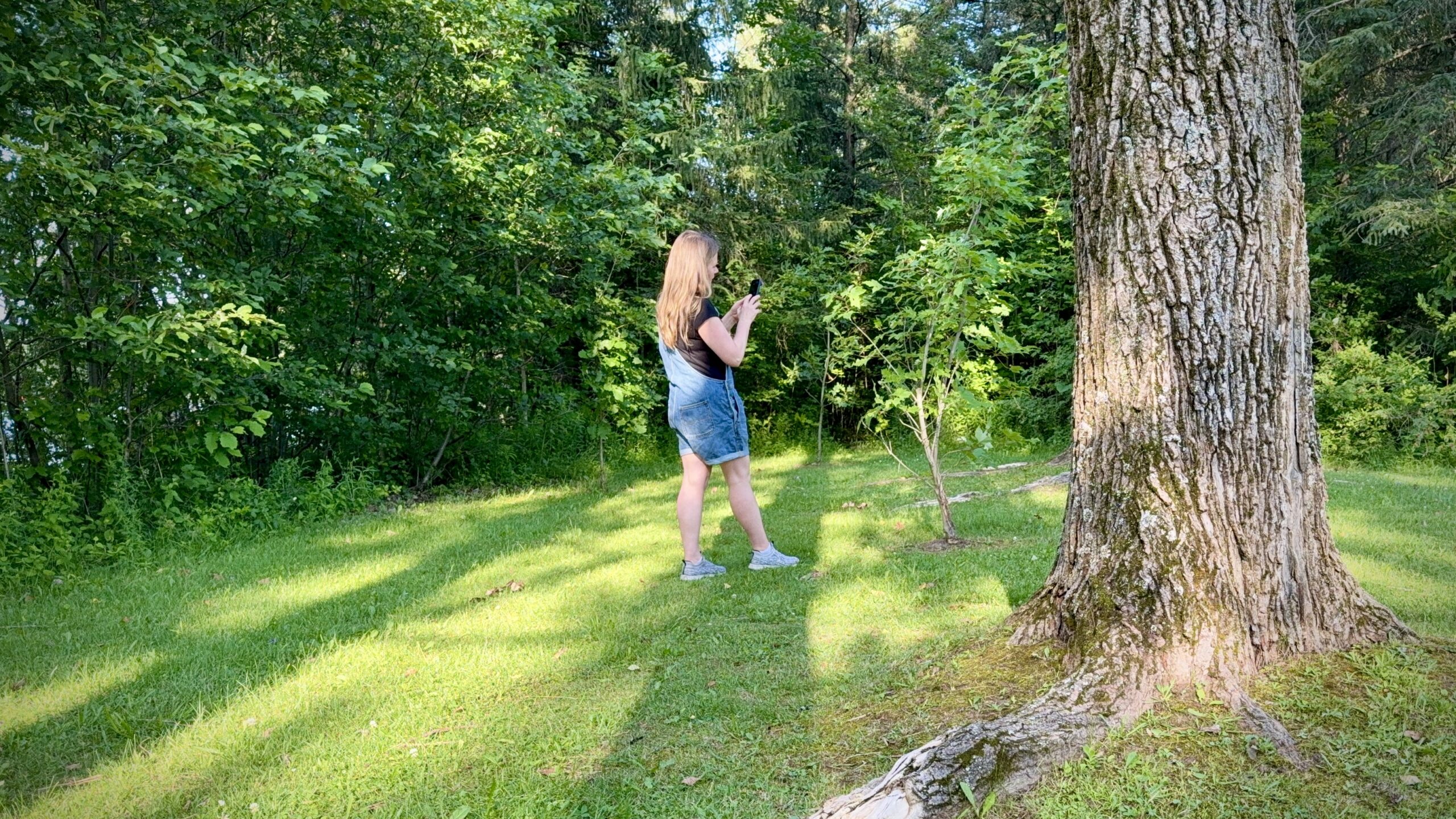
Last time, I made the case for bringing your phone outside with you. Not to scroll. To use. As a timer, a camera, a way to name the plant in your hand, a thread home so no one worries while you stand under a tree and let your shoulders drop. The phone can help you be present. I meant it.
But I left one thing barely touched. The real trouble with our phones is not the phone. It is the feed.
You know the posture. Head down, shoulders rounded, thumb moving. We have all been that person, and we have all watched that person. Social media has settled into the ordinary hours of our lives. Some of us keep it to a small reward at the end of a long day. Some of us lose whole evenings to it. It slips into the spaces where we might have talked to the person across the table, or watched the light change, or slept. It fills every pocket of boredom. It follows us to work. It follows some of us into the car, which is where it stops being harmless.

And it is not all bad. That’s the honest part. People are so funny and generous and clever on there. It carries art and ideas and whole conversations you would never find in your own town. It can open the world. For someone who has felt alone in their corner of it, that opening can matter a great deal. So I am not here to tell you it’s poison.
The science will not tell you that either. We have spent a decade looking for hard proof that social media makes us anxious or depressed, and that proof has not arrived, at least not at the scale people expected. Careful researchers still disagree, in good faith, about what the numbers even show. I’m not going to pretend that argument is finished. It’s not.
Here’s the part that’s not in dispute.
The feed was designed to take your attention. Not by accident. On purpose, by people who have since said so out loud.
Infinite scroll, the reason the page never ends, was built around 2006 by a designer named Aza Raskin. He has spent years regretting it. By his own estimate it now wastes something like 200,000 lifetimes every day, time a page with an end would have handed back to us. The trick underneath it is old. You feel the strongest pull to keep going not when you get the reward, but when you might. The maybe is the hook. It is the same wiring a slot machine runs on. Pull to refresh, that little tug at the top of the screen, was built to feel like the lever. Another former designer, Tristan Harris, called the phone “a slot machine in your pocket,” and in 2019 he told the US Senate the whole industry was in a race to the bottom of the brainstem.
So when we look around at the hunched shoulders and the thumb that cannot stop, and we sigh and say it’s the phones, we are not quite right. We are watching the pull of the feed. The phone is only what it happens to live on.
And the phone, on its own, is something else.
The phone is a tool. It is close to magic, when you stop to notice. Remember when news was slow, when information was hard to reach, when taking a single photo was an event. I think of a trip to Paris years ago, on my own, a little pink BlackBerry in my pocket. A map when I got lost. A few words home. Some translation, a bit of a travel guide, the ability to take a few photos. None of it pulled me out of the city. It let me be further inside it.
It helps to see that two kinds of apps live on one device.
One kind is a tool. A map. A camera. A flashlight. A guide that names the plant in your hand. Every one of them has an end. You open it, it does its work, it lets you go. The map ends when you arrive. The name comes and the search is over. The voice memo stops when you stop talking.
The other kind is a feed. A feed has no end. That was the whole point. It is built so you never reach it, so there is never a natural place to look up.

So here is a simple question you can ask of anything on your phone. Is there an end? A tool ends, and it returns you to your life. A feed does not, and it is built so you never leave.

Bring your phone, then. Just keep an eye on where your attention goes. If you have stepped outside to feel more like yourself, some part of you already knows you are not out here to scroll. So log out of the feed. Start small. A few minutes. An afternoon. A weekend. Work up to a week if you can. Keep the tools. Keep the camera and the map and the way home. Set down the one thing that was built to hold your attention.
I did not plan the timing of this, but here it is. I have been building a little, low-tech app for exactly this moment. It is not a feed. It has an end. It is a helpful container for your time outside, a way to keep track of the hours you give to the natural world, and a short set of questions that lead you back toward yourself. It was built to support a nature connection habit you can actually keep.

I think of it as light. Each of us has a light to shine, something only we can offer. When we spend all our hours taking in everyone else’s, especially through the feed, we can lose contact with our own. The talking heads crowd out our own voice, the part of us that wants to be with a person, a dog, a plant, a patch of moss. Step back from the feed, even a little, and your attention comes back to your own voice, your own intuition. With time, and small returns to it, that voice gets easier to hear.
A light is also meant to be given. It’s easy to share yours online, and that has its own kind of good. But the world right in front of you deserves it too. The person across the table. The path under your feet. The tree waving its leaves above you. Put your attention there, and you’re no longer only taking light in. You’re adding yours to the here and now.
Worth a listen and a read
Charlie Warzel and Kaitlyn Tiffany, “Flipping Off Phones,” Galaxy Brain, The Atlantic, May 2026. A candid conversation about the flip-phone movement and why, even with the backlash growing, the science on whether phones directly harm us remains far from conclusive. https://www.theatlantic.com/podcasts/2026/05/flipping-off-phones/687102/
Candice Odgers, “The great rewiring: is social media really behind an epidemic of teenage mental illness?” Nature, March 2024. A careful argument that the evidence blaming screens for rising teen depression is equivocal, and that most of the data are correlative rather than causal.
https://www.nature.com/articles/d41586-024-00902-2