
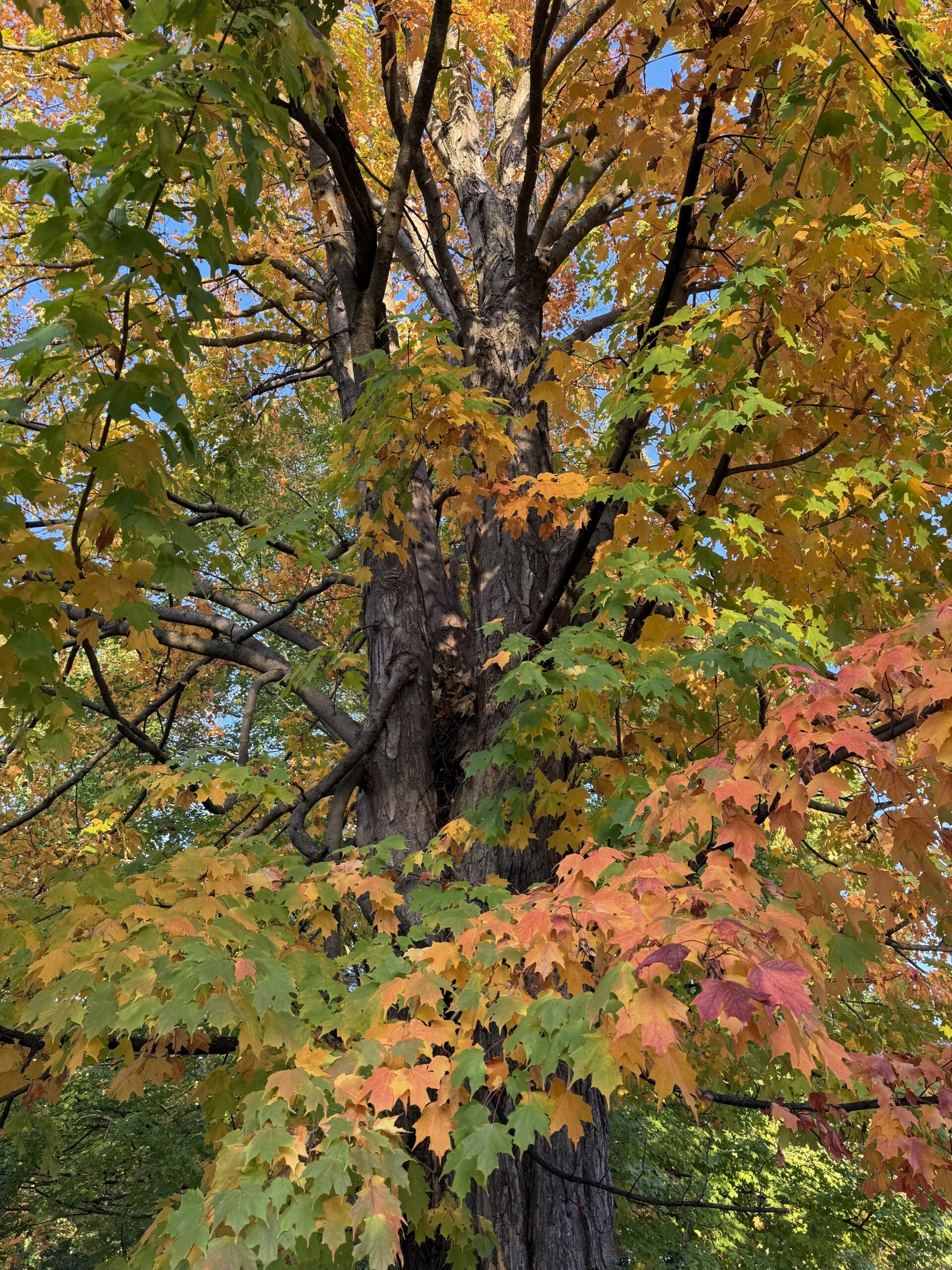
A down-to-earth practice for finding your footing when the world, your phone, or your own life is too much.
Sometimes the news is awful and it sends you into a tailspin. Sometimes the hard thing is much closer. A divorce. A job loss. The death of someone you love, or a diagnosis that leaves you with more questions than answers. A move or an empty nest can shake your sense of home. Perimenopause can disrupt your sleep and make an already full life feel more chaotic than you ever imagined. You reach for your phone to find out more, ask someone, get organized. Before long, you are taking in everyone else’s reaction as well as your own.
I understand the reach for information. That easy access is one of the biggest boons of our lifetime, and yet it can all become too much, too fast. I use my phone, and I even bring it on my solo walks. But I manage it because there comes a point when more input does not tell me how I am doing. It can even make it harder to hear myself.
When the pandemic began, I had just trained as a forest therapy guide. I could read the updates and feel my anxiety climbing. Walking to a green space gave me something I could actually do. The situation was still real when I got home. I was able to meet it with a little more of myself present.
That is why I keep coming back to nature connection when life gets difficult. We need to know what is happening in the world, and we also need a way to notice what is happening in us. As I walked each day I noticed that my feelings got clearer and the next steps followed. Drawing upon my coaching and forest therapy guide training and came up with STELLAR, a process for deeper listening to yourself and asking what small step you want to take today.
Give your attention somewhere to land
You do not need a pristine forest far from the city or a perfect mood and abundant energy. A tree along your street will do. So will the changing light on a windowsill, a weed in the pavement, or birds making an absolute racket outside your kitchen.
For a few minutes, let yourself look without trying to accomplish anything. Watch the movement of a branch. Notice one colour you missed at first. Hear the sound behind the loudest sound. Let something catch your interest without asking it to be useful.
Researchers call this kind of lightly held attention soft fascination. It is part of a theory about how restorative places may give effortful attention a rest. The language can sound technical; the experience is familiar. You notice a leaf turning over in the wind and, for a moment, you are simply there with it.

Sometimes there is surprise. A mushroom where there was bare ground yesterday. A butterfly. A patch of red in a tree that still looks green from across the street. Sometimes there is awe. Sometimes you notice nothing remarkable at all, and that is fine too. Nature connection is a relationship, not a performance.
Your phone can come with you. Silence notifications, keep it in a pocket, and use it if you want a photograph, a note, or a way to get home safely. Let the phone serve the moment you are in. I call this Leave the Feed, Not the Phone.
What nature offers when you are carrying a lot
This is more than a lovely change of scenery. Depending on the person, the place, and the kind of visit, research points to several kinds of support:
- A break from rumination. In one experiment, people who took a 90-minute nature walk reported less repetitive negative thinking afterward than people who walked in an urban setting. When I tune in to what’s around me, I have something else to attend to besides the same thought on repeat.
- Some relief from anxious feelings. In a separate experiment, a 50-minute nature walk produced a greater decrease in how anxious participants felt at that moment than an urban walk. That is a finding about state anxiety, not a promise that nature treats an anxiety disorder. If anxiety is what you are carrying, try noticing one safe, familiar detail before asking anything more of yourself.
- Room for attention. Experiments have found improvements on attention tasks after a nature walk or even viewing nature images. A newer study comparing 40-minute nature and urban walks found a brain activity pattern consistent with less demand on executive attention after the nature walk. I think of this as giving my busy mind room to breathe.
- A shift in mood. In that 40-minute walking study, both groups felt better, but the nature group had a greater lift in positive mood. In a smaller winter study, people who spent two weeks noticing everyday nature and how it made them feel reported gains in several measures of well-being.
- Support for the body under stress. In a small study of self-chosen urban nature breaks, researchers measured a fall in salivary cortisol beyond its usual daily decline. That is a stress marker, not proof that every visit lowers everyone’s stress. The body is part of this story, though, and it deserves our attention.
- Space for creative thinking. A study of hikers found better performance on a creative problem-solving task after several days outdoors. Those hikers were also away from their devices and daily routines, so we cannot give nature all the credit. Still, it makes me want to leave a little space for an unexpected idea to arrive.
- A connection to meaning and possibly to longer-term health. Short experiments with noticing and photographing everyday nature have found gains in meaning and well-being. A large population study found that people reporting at least two hours of recreational nature time in a week were more likely to report good health and well-being. That association does not show that nature caused their good health or that two hours is a required dose.
None of this requires you to turn your walk into a treatment plan. The research helps explain why a pause with the living world can matter. You may notice a change in your thoughts, your mood, or your body; you may simply find enough space to hear what you need.
The three Listen questions
Once you have had a little time to look around, turn toward yourself. I call these the three Listen questions because Listen is one movement of STELLAR:
How am I feeling?
You might be frightened, furious, numb, sad, oddly hopeful, or several things at once. There is no need to trade a difficult feeling for a nicer one before you are allowed to continue.
Then ask: What do I want? You may want reassurance, a conversation, a boundary, food, rest, a plan, or help. And because the first answer is not always the whole answer, ask: Is there anything else?
You might realize that beneath “I want to know what everyone thinks” is “I want to know I will be okay.” Or beneath “I need to do something right now” is “I need someone beside me while I figure out what to do.” These are possibilities, not answers I can give you. The point of the questions is to hear your answer.
How I use STELLAR when things are hard
Here are the seven movements give me a way to return to myself and then return to my life:
- Shed: Notice what you are carrying. Name a feeling; loosen your grip on what is not yours to carry right now. You do not have to forgive, release, or feel better on command.
- Trust: Feel the ground, the air, the company of other living things. Begin with the trust you can actually find: perhaps you can trust yourself to notice what is true today.
- Explore: Follow your senses. Let curiosity and surprise have a little room, even if your worries have come along.
- Listen: Ask the three Listen questions: “How am I feeling? What do I want? Is there anything else?” Pay attention to the answers that come through your body as well as your thoughts.
- Live: Choose one small action consistent with what you heard. Drink water. Call someone. Make the appointment. Say no. Take the next necessary step.
- Awareness: Notice your patterns without attacking yourself. Did the feed or newsreel make you feel informed, overwhelmed, or both? What helps you stay connected to your life?
- Remain Open: Come back tomorrow. A new day may bring a different feeling, a new answer, or a different kind of help.
You do not need to complete seven tidy steps on every walk. On some days, looking at the sky and admitting “I’m scared” is enough. On others, you may come home knowing exactly which phone call to make.

What the research can and cannot tell us
The studies above measure different things: a single walk, a few weeks of deliberate noticing, several days away hiking, or people’s reported habits and health. We cannot combine them into a promise that three minutes outside will produce every benefit on that list.
The 2026 photography trial gives me one more reason to care about an easy practice: after seven days, college students in both nature photography groups had improved measures of meaning and well-being compared with a waitlist group, but those gains had faded a month later. We do not know whether continuing a daily practice would have maintained them. I love that noticing did not require travelling somewhere spectacular, and I am curious about what helps people keep returning.
STELLAR is my way of bringing attention, honest questions, and small actions together. Those studies did not test STELLAR as a complete method. They help explain why its everyday nature connection component is worth exploring.
Take a moment to hear yourself think and try the Three-Minute Landing
The Three-Minute Landing is a doorway into STELLAR. Go to a place where you can notice something living, even if it is your doorstep or a window. For three unhurried minutes, notice one thing moving, one thing changing, and one thing you can feel, such as air on your face or the chair beneath you. See if anything surprises you. It does not have to.
Then use the three Listen questions: How am I feeling? What do I want? Is there anything else? If an action comes to mind, make it small enough to do today. If nothing comes, let noticing be what you did today.
If you would like a daily invitation to return, Sève is the nature practice I made for that purpose. The three Listen questions are one way into STELLAR; the Sève 5 questions. You can bring your phone outside, then put it away and meet the world around you.
The hard thing may still be there when you come inside. You may need help from other people, or more than a walk can offer. But being outside gives me perspective. This world is wild and astonishing, and I get to be here among it all. I can take that in for a few minutes, let my body and mind be, so I’m better able to face what comes next.

Research behind this post
- White et al. (2019), Spending at least 120 minutes a week in nature is associated with good health and wellbeing. Observational study; no causal threshold established.
- Kaplan (1995), The restorative benefits of nature: Toward an integrative framework. Theory of attention restoration and soft fascination.
- Bratman et al. (2015), Nature experience reduces rumination and subgenual prefrontal cortex activation. Comparison of 90-minute nature and urban walks.
- Bratman et al. (2015), The benefits of nature experience: Improved affect and cognition. Comparison of 50-minute nature and urban walks measuring momentary anxiety, mood, rumination, and cognition.
- Berman, Jonides & Kaplan (2008), The cognitive benefits of interacting with nature. Experiments measuring directed attention after walking or viewing images.
- McDonnell & Strayer (2024), The influence of a walk in nature on human resting brain activity. Randomized 40-minute walk comparison; positive affect and EEG measures.
- Hunter, Gillespie & Chen (2019), Urban nature experiences reduce stress in the context of daily life based on salivary biomarkers. Small repeated-measures field study; cortisol is one stress marker.
- Atchley, Strayer & Atchley (2012), Creativity in the Wild. Hiking study; cannot separate nature from time away from technology and routine.
- Passmore, Yargeau & Blench (2022), Wellbeing in Winter: Testing the Noticing Nature Intervention During Winter Months. Small randomized study in community adults.
- Nature-based meaning-focused photography intervention enhances subjective well-being (2026). Randomized study of 219 college students; effects did not persist at one month.
Leave a Reply