
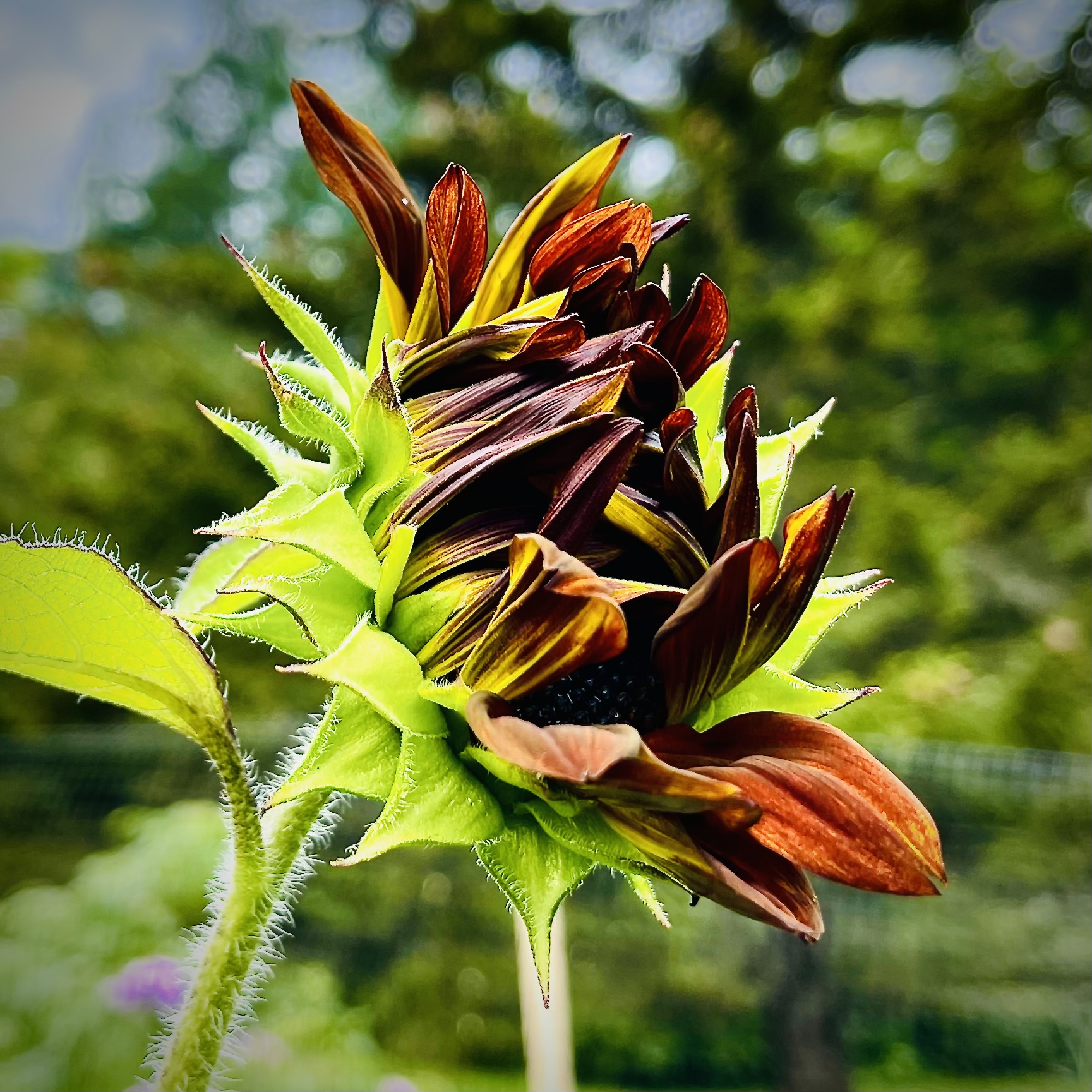
A few years ago in late May, I found myself stopping on my walk, caught by the new leaves, backlit by afternoon sun, covered in the finest hair. I started photographing them. They reminded me of the fine hairs on my arms, the ones that stand when I am cold, or feel an emotion deeply, like when a story gives you chills. It made me wonder what it’s like to be a leaf. Do they feel the same way we do? Can they sense in a way that we humans do?

Turns out, those tiny hairs have a name. Trichomes. And what they do is more interesting than I expected.
Trichomes (try-combs) come from the Greek word for hair. And on a new leaf, they’re not decoration. Before the leaf has developed its full outer layer, its waxy coat, its permanent skin, the trichomes are doing that job entirely on their own. A young leaf can invest up to 40% of its entire dry mass in that fine layer of hair. Forty percent. More than it will ever spend on anything again.
They protect against frost. Against wind. Against too much sun hitting tissue that isn’t ready for it yet. They slow down what’s coming in, and they report back on what’s out there. Trichomes are also sensory. When something touches them, they transmit a signal deep into the plant’s cells. The whole system responds.
They are, in the most literal sense, how a new leaf feels its world before it’s ready to face it alone.

I’ve been thinking about this in relation to people.
There’s a term you may have come across: Highly Sensitive Person, or HSP. It was coined by psychologist Elaine Aron in the 1990s and has since been studied across dozens of peer-reviewed studies. Roughly 15 to 20 percent of the population has this trait, a nervous system that processes sensory and emotional information more deeply than most. Not a disorder. Not a diagnosis. A biological variation, like being left-handed or having perfect pitch.
Some plants, like nettle, tomato, and sunflower, keep their trichomes at full density their whole lives. Not because they never matured. Because that sensitivity is how they’re designed to thrive.
If you’ve spent your life being told you’re too sensitive, that you feel things too deeply, that you need to toughen up, this is worth knowing.
Sensitivity is not immaturity. You’re not being a baby when you feel big feelings as you experience life. Some moments are genuinely sad. When something we love ends, feeling that loss deeply isn’t a deficiency. That’s what love feels like on the way out. Sometimes being the receiver of the careless actions of others can create a flash of anger in us. It’s not a failure to develop thicker skin. It might be a warning that you require more.
For some people, like the plants that keep their trichomes, it’s simply how they’re designed to move through the world. Feeling more. Noticing more. Picking up on what others walk right past.
The research calls it differential susceptibility. What it means in plain language is this: sensitive people are more affected by their environments in both directions. Harsh, chaotic, overstimulating environments land harder. But supportive, nourishing, quiet environments? They heal more deeply too.
The same nervous system that makes the noise louder also makes the stillness more restorative.

This is why I keep coming back to greenspaces. Not because nature is pretty, though it is. Not because walking is good for you, though it is. But because for people whose nervous systems run a little hotter than average, nature offers something specific.
A 2019 Finnish field study found that noise-sensitive people restored most in woodland and urban parks, and that the city centre didn’t restore them at all. Not less. Not a little. Not at all. The environment type mattered more for sensitive people than for anyone else in the study.
A 2025 study of over 1,500 people found that birdsong specifically drives wellbeing through three pathways: restoring attention, reducing stress, and generating awe. Not a grand wilderness experience. The simplest possible conditions, including birds, quiet, and a little time.
You probably already knew this in your body. You just didn’t have the language for it.
More than ever, our nervous systems need restoration. Not a vacation, not a dramatic retreat. Stepping outside, away from screens and noise and other people’s needs, gives the nervous system something it genuinely cannot get indoors: a chance to recalibrate. Take your phone if you need to. Set a timer. Then put it in your pocket and let your body do what it already knows how to do.

So here’s what I want to offer you.
If you are someone who feels things deeply, who notices what others walk past, who finds the world loud more often than not, you don’t need to fix that. You need conditions that can hold it.
Twenty minutes. A greenspace, a backyard, a bench under a tree. Not to think your way through anything, not to be productive about it. Simply to allow your nervous system to remember its natural state. Outside the daily static. Within the larger, nourishing systems of life that have always been there, waiting.
Start there. Notice what arrives when the noise turns down.
I built Sève for exactly this. A daily nature connection practice for people who are good at powering through and have slowly lost the thread back to themselves. Five reflective questions. A few minutes outside. A feeling check-in that doesn’t try to fix anything. It simply names what’s there. A small place to return to, every day.
If that resonates, I’d love for you to try it.
And if you want to begin right now, I made you something. A short audio guide called Fresh and New. A few minutes, a new leaf, and something worth knowing about what it means to feel everything.