
Maybe you’ve spent years being the strong one.
The thoughtful one. The one who keeps going. The one who notices what everyone else needs before they notice it themselves. And maybe lately, that way of living, the overgiving, the over-responsibility, just isn’t working anymore.
If that landed for you, stay with me.
The thing nobody names
There is a word for the unpaid, unrecognized work of holding everything together: emotional labour. Sociologist Arlie Hochschild first named it in 1983, describing the invisible work of managing our emotions to meet the expectations of others. Four decades later, research confirms what many women already know in their bodies: this labour falls disproportionately on us.
Globally, women perform three-quarters of all unpaid care work, averaging more than four hours per day compared to just over one hour for men. In North America, two-thirds of all unpaid caregiving is done by women, work valued by economists at over one trillion dollars annually, and compensated at exactly zero.
This is not a character flaw. It is a pattern so deeply woven into how women are raised, socialized, and rewarded that it can be nearly impossible to see from the inside. We are praised for our patience, our flexibility, our devotion. We are described as having it all together.
But from the inside, it can feel very different.
What overgiving actually looks like
Overgiving rarely announces itself. It doesn’t show up as a dramatic breakdown or a clear moment of refusal. It creeps in over time, in ways that are easy to explain away.
It looks like always being available. Like saying yes when you mean no. Like knowing what everyone in the room needs before you’ve checked in with yourself. Like lying awake thinking about other people’s problems. Like resentment that surprises you, toward people you genuinely love.
Research on burnout confirms what this pattern costs. Women consistently score higher on emotional exhaustion than men, and studies point to sociocultural factors as the cause: the expectation that women will manage not just their own emotions, but everyone else’s too. When that management becomes relentless and invisible, the nervous system begins to register the cost.
At some point, the body feels it. Your clarity feels it. Your joy feels it.
What I eventually had to confront was this: the belief that I could keep functioning this way without paying a price was not strength. It was a story I had inherited. And it was costing me.
The feminist truth underneath this
This deserves to be said, because it often gets left out of wellness conversations:
The reason so many women are exhausted is not a personal failing. It is the result of living inside systems that have long treated women’s time, energy, and emotional capacity as infinitely available resources. We absorbed this early. We were shaped by it. And many of us have spent years trying to heal what was never ours to carry in the first place.
Your life matters. Your energy matters. Your needs are not an afterthought.
This is not a radical idea, but it can feel like one when you’ve spent years living as though everyone else’s comfort comes first.
Choosing yourself is not selfish. It is the beginning of having something real to offer. You can only give what flows freely.

The return
What helped me was not more discipline, more strategy, or more effort.
What helped was a letting go and letting be. I make time each day to return to myself. Through honesty. Through self-trust. Through the daily practice of listening to what was actually true for me.
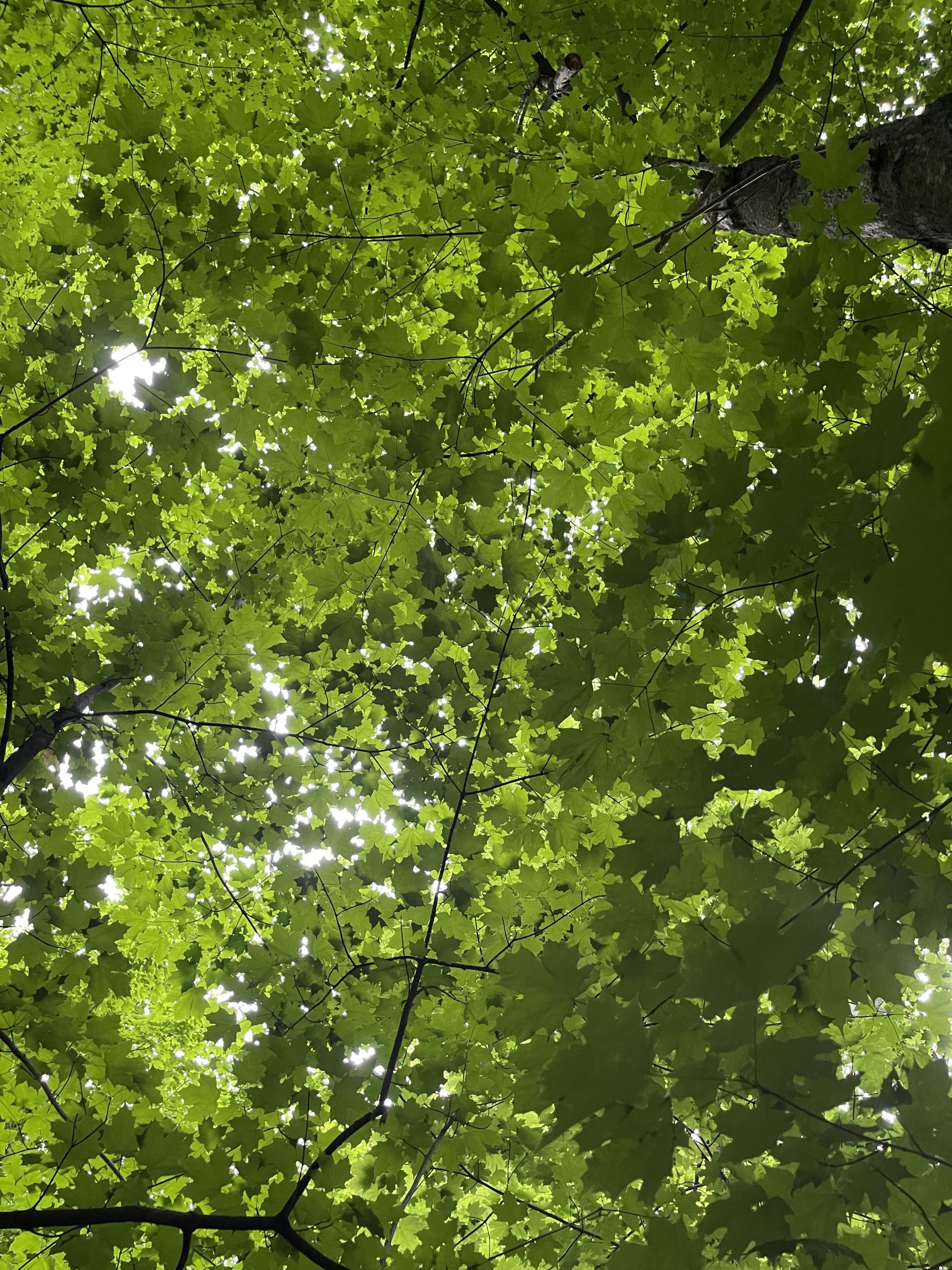
And part of that return came through time in nature.
I mean that practically, not poetically. When I am emotionally overloaded, more thinking rarely helps first. What helps is contact with something real. The air. The light. The ground under my feet. A soundscape that isn’t asking anything of me. I am able to let go, be in the present moment, all in the company of a world teeming with life, beyond me, reflecting me, a part of me.
There is a distinction worth naming here. Time in nature is simply that: being outside, present to the living world. Nature connection goes a step further. It is the intention to relate to that world, to the plants and animals around you, and it can happen anywhere, even indoors. Both matter. Both count.
Research from the University of Exeter found that spending as little as 17 minutes per day in nature is associated with measurable improvements in wellbeing. Not hours. Not a retreat. Just consistent, small contact with the living world.
That kind of contact helps the body settle enough to listen. Not perfectly. Not magically. But enough to begin noticing what’s true.
Small returns
Healing and rebuilding self-trust are rarely dramatic transformations. They tend to be the very thing we visit again and again, in the little moments.
They happen in small returns. Small honest moments. Small choices to stop abandoning yourself for the sake of keeping the peace.
This is the work I am now building Sève to support.
Sève means sap in French: the life moving through a tree, often before we can see any visible change from the outside. That image feels right for this kind of return to self. Something moving beneath the surface. Something rising from the core and supporting all we are.
Sève is a simple daily practice app for women who are ready to tend to themselves first. They know that this tending improves their lives and the lives of those they love. The return is exponential. Five reflective questions. A nature tracker. Audio guides for the moments when you need to be led back to yourself. A small place to return.
Not another thing to keep up with perfectly. Just a daily reminder that your life deserves your attention too.
A practice to take with you today
Notice one place where your energy leaks out through habit, pressure, or guilt.
You don’t need to fix it. You don’t need to change anything today.
Just notice.
Where am I giving from truth? And where am I giving from pressure?
That honest attention is often where self-trust begins to rebuild.

Tamara Schmidt is a life coach, nature therapy guide, and herbalist, and the founder of Fleurbain and Sève.
She lives and practices in the Eastern Townships of Quebec.
Sève is now open to founding members.
Learn more at: