
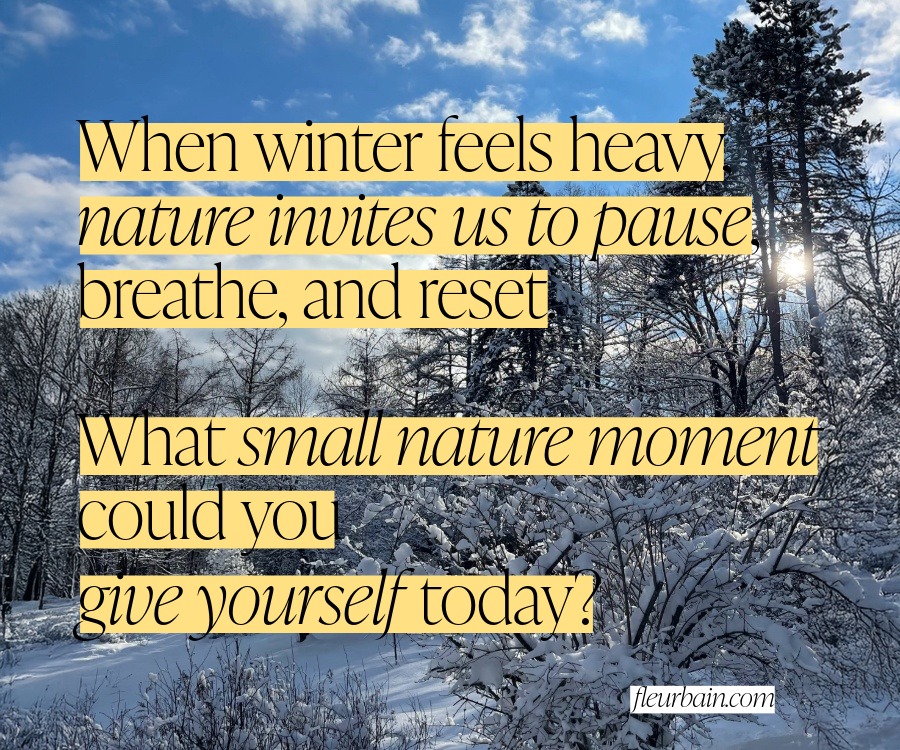
Winter in the Townships can be heartbreakingly beautiful. Cozy sweaters, fresh snow on the branches, the sudden quiet after a storm. But under that beauty, a lot of us are navigating something harder.
The days are short. The cold settles deep in our bones. Ice makes getting around difficult or scary. Social plans get cancelled, or we just don’t have the energy to make them. Our bodies slow down, our minds feel foggier, and sometimes we don’t quite feel like ourselves.
For some women, Seasonal Affective Disorder (SAD) is part of this picture, and medical support really matters. Alongside that, there are gentle, accessible things we can do to support our mental health and sense of self through the darkest months.
One of the most powerful tools I know is something I work with every day: nature connection.
What I Mean by “Nature Connection” (It’s Easier Than It Sounds)
When I say nature connection, I don’t mean snowshoeing for hours or driving to a national park.
Nature connection is the practice of supporting your own ability to be in relationship with the living world, on purpose. In other words, nature connection is noticing and relating to the living world. In winter, this kind of nature connection can be a powerful way to support ourselves.
It’s the practice of slowing down enough to notice and appreciate the nature that’s already around you:
- a tree on your street or outside your window
- the particular shade of the winter sky at 4:15 p.m.
- a houseplant on your table
- the sound of wind, or crows
- the taste and scent of herbs in your tea
Here in the Townships, we’re surrounded by nature, but winter can make it feel far away. The lovely part is: you don’t always have to go far. Yes, getting outside helps, but even on the harshest days you can still connect with nature from indoors.
A few everyday winter examples:
- Pausing at the window to really watch the snow fall instead of automatically reaching for your phone.
- Stepping outside your door for two minutes and feeling the air on your face.
- Noticing the shape of bare branches against a grey, pink, or blue sky.
- Making a cup of herbal tea and remembering it grew from soil, water, and sun.
- Returning to the same tree or view each week to notice what’s changed (light, snow, tracks, buds).
Because it’s a relationship, I also like to include a gesture of respect such as offering gratitude, or offering a bit of care, such as picking up a bit of litter when I’m outdoors.
None of this requires extra money or a big time commitment. It’s mainly a shift in attention, choosing to include nature as part of your day instead of something you pass by on the way to the next task.
How Nature Helps Your Brain and Body (A Little Science)
If you feel better after being outside, it’s not “all in your head” in the dismissive sense. It is in your head… and your hormones, nervous system, and brain… in a very real way.
Researchers in environmental psychology and neuroscience have been studying this for decades. A few themes are especially relevant in winter:
1. Nature helps lower stress hormones
Many studies suggest that short periods of time in natural settings can lower cortisol, one of the body’s main stress hormones. A “nature dose” study found that as little as 10–30 minutes of sitting or walking in nature can significantly improve markers of wellbeing, including cortisol levels.
In one study, researchers used the phrase ‘nature pill’ as a shorthand metaphor—suggesting that a 20–30 minute nature experience can support a measurable drop in cortisol beyond normal daily rhythms.
2. Nature helps restore attention and reduce mental fatigue
Stephen and Rachel Kaplan’s Attention Restoration Theory suggests that natural environments can give our “task-focused” brain a rest. Instead of demanding concentration, nature offers what they call soft fascination—things that hold our attention gently (like clouds moving or branches swaying) and allow our minds to recover from constant demands.
Even looking at images of nature or having a window view of trees has been linked with better focus, less mental fatigue, and improved performance on attention tests.
3. Green space supports mood and reduces risk of mental illness
Large meta-analyses have found that people with greater exposure to green space—parks, trees, gardens—tend to have lower rates of depression and anxiety.
In other words, being able to access nature isn’t just “nice to have.” It’s increasingly recognized as a protective factor for mental health.

4. Awe and beauty can shift how we feel
Experiences of awe—those small “wow” moments when you see a breathtaking sky or frost pattern—have been linked with reduced depressive symptoms and better overall wellbeing.
Researchers suggest that awe helps us feel part of something larger than ourselves, which can loosen the tight grip of rumination and worry.
5. Nature supports interoception: listening to your inner world
Interoception is our sense of what’s happening inside our bodies. Neuroscientist A.D. Craig describes interoception as how we perceive our internal state—our heartbeat, breathing, tension, energy levels, and emotional tone—through networks in the insula region of the brain.
When we slow down in nature, it often becomes easier to feel those inner signals. Instead of pushing past our limits, we can notice: “My chest is tight,” “My jaw is clenched,” “My shoulders just dropped a little.” That awareness is often the first step toward self-compassion and better choices.
How Nature Connection Has Carried Me
For me, nature connection isn’t a cute idea I talk about in workshops; it has carried me through some of the hardest seasons of my life. When I’ve felt anxious, drained, or unsure of who I was becoming, simple moments outdoors became a way to come back to centre. This was especially true during these difficult, shape-shifting days of perimenopause, when my body and emotions have felt unfamiliar.

Standing beside a familiar tree, watching the sky change, or feeling snow under my boots has helped me notice what was happening inside my body: my breathing, the tightness in my chest, that fluttery feeling in my stomach, and whether I was able to relax or not.
When I give myself that space in nature, I can feel my feelings, name them, and begin to determine what I want and need. These small pauses have led to much bigger questions:
- What do I really want in my life?
- What do I want to do?
- How can I create a life that reflects more of who I am now?
Answering those questions starts with being able to feel what’s going on inside.
I keep going back to nature after breakups, during stressful work periods, or when everything feels heavy. I might be convinced there’s no way out of the pain, and then I step outside, walk through fresh snow for 15 minutes, watch chickadees on a bitter day, and suddenly I notice my breath slowing and my shoulders dropping. I haven’t “fixed” my life, but I’ve found myself again. From there, it’s easier to take the next kind step for myself.
Nature doesn’t magically solve everything. But it often quiets rumination and helps me loosen my grip on what’s beyond my control, and it helps my inner light feel steadier. It gives me something solid to lean into when my mind is spinning: tree bark, cold air, the crunch of snow, the slow lengthening of daylight.
Women, Invisible Labour, and Winter
Many women I work with are carrying an enormous load: emotional care, household management, elder care, parenting, community involvement, the constant job of “keeping an eye on everything.”
Winter can amplify that exhaustion. The logistics become harder. Bodies ache more. Old stories of “I should just push through” or “Everyone else has it together” can get louder.
Nature offers a different story:
- You are part of something larger than your to-do list.
- You’re allowed to rest and restore, winter reminds us that rest is part of life.
- Your inner fire doesn’t have to be dramatic to be worth tending.
Seeing our own wellbeing as worthy of care is, in many ways, feminist work. It’s about reclaiming our energy and humanity in a world that often expects women to be endlessly available.

Simple Winter Practices
(Micro, Mini, and Deeper)
To make this practical, here are three levels of winter nature connection you can play with.
Micro (1–2 minutes)
- Open a window, feel the air on your face, and take three slower breaths.
- Look up at the sky and name three colours you see.
- Put your hand on a houseplant or wooden table and notice the texture.
Mini (5–10 minutes)
- Stand at a window with a hot drink and watch whatever is moving: snow, people, cars, crows, clouds.
- Take a short walk and focus on sound: crunching snow, distant traffic, a dog barking, your own footsteps.
- Sit near a tree or hedge and notice patterns: lines in bark, shapes of branches, tracks in the snow.
Deeper (15–30 minutes)
- Go for a slow walk with no podcast, no phone in your hand. Let your mind wander and just notice what you see, hear, and feel.
- Use your phone or a notebook to quickly jot down three things you appreciated in nature that day.
- Choose a “winter sit spot” and visit it regularly through the season.

A Note About the Phone…
It’s okay to have your phone with you, but it helps to turn off notifications and stay off social media while you’re outside.
You can use your phone to:
- set a timer so you’re not worrying about the time
- record a quick voice note about what you’re noticing or feeling
- jot down a few lines in a notes app, like a tiny field journal
The phone itself isn’t the problem. It’s the constant distraction that gets in the way of the nervous system reset we’re hoping for. The more you can manage those distractions, the more nourishing your time outside will feel.
How My Pocket Guide to Winter Nature Connection Can Help
Winter is often when we say things like:
- “I know going outside helps, but I just… don’t.”
- “I’m so tired of making decisions. Even choosing how to care for myself feels like work.”
- “I want to feel grounded and calm, but my brain is mush by the time I have a minute to myself.”
This is exactly why I created my Pocket Guide to Winter Nature Connection.
If you’re a sensitive woman in midlife who tends to take on a lot and is trying to hold many pieces together, this guide is for you.
It’s a small, printable and digital guide designed for low-energy days and busy minds. Instead of giving you a huge list of things you “should” do, it offers simple, specific invitations you can try in 5–15 minutes, including:
- short guided practices you can take with you on a walk or to your window
- reflection prompts that help you notice what’s happening inside (body, emotions, energy)
- gentle ideas for bringing nature indoors when going out isn’t realistic
You don’t need to already be “good” at meditation, journaling, or self-care. You don’t need to love winter. You just need a tiny bit of willingness and something concrete to lean on when your brain is tired and your energy is low.
If this speaks to you, you’ll find all the details about the Pocket Guide to Winter Nature Connection here. The guide I’ve created is companion for anyone who wants to feel a little more steady, present, and supported this winter.

You might also like:
- Hunny, You Shrunk My Hippocampus – on how chronic stress and emotional abuse affect the brain, and why gentle, daily practices (including nature) matter.
- Let’s Not New Year, New You – a kinder January reset for real humans in real winters.
- Coming Back to Yourself: The Gold in Authentic Self Compassion – on healing, self-compassion, and slowly rebuilding a life that fits.

Comments
One response to “Tending Our Fire: How Winter Nature Connection Supports Women’s Mental Health”
I love going on nature walks and talking to the big beautiful spruce we have in our area. The original blue ones were planted but are now surrounded by offspring. I feel really refreshed after spending time with them.