
Have you ever noticed how stepping outside for just a few minutes can shift something inside you? Maybe the tension in your chest relaxes, or your breath feels deeper, or the swirl of thoughts in your head slows down just enough to let you catch your bearings. That’s not an accident. It’s your nervous system responding to nature’s invitation, a moment of grounding that begins the process of nervous system regulation.

For many of us, life has demanded long stretches in survival mode. Hypervigilance, worry, and pushing through have become the norm. Even the constant pull of our devices — endless notifications, news cycles, and messages — keeps our systems on high alert. Add in traffic jams, family responsibilities, work deadlines, and the unspoken pressure to “keep it all together,” and it’s no wonder our bodies forget what safety feels like.
Yet there is another way of being available to us — a path toward safety, presence, and even joy. And one of the simplest, most reliable guides we have is the natural world.
Understanding Survival Mode and the Nervous System
Survival mode isn’t weakness — it’s biology. When our nervous system senses danger, it shifts into protection. According to polyvagal theory, described beautifully by Deb Dana in Anchored, we move between different states:
- Fight or Flight: mobilized, on edge, scanning for threat.
- Freeze or Shutdown: collapsed, numb, disconnected.
- Safety and Connection: calm, open, and able to engage with others and with life.
These states aren’t choices at first. They’re automatic responses designed to keep us alive. But here’s the hopeful part: once we understand what’s happening, we can gently guide ourselves back toward safety. We don’t have to live forever in survival mode.
Nature as Regulator and Teacher
This is where nature comes in. Daily contact with the natural world gives us a direct, embodied way to shift our nervous systems.
Science backs this up: cortisol (our stress hormone) drops measurably after just 20 minutes outside. Looking at trees improves focus. Experiences of awe in nature reduce rumination and expand our sense of connection.
Lived experience confirms it: when I spend time outdoors, even for a few minutes, I notice more of what I’m feeling. I catch glimpses of awe — the shimmer of light through leaves, a bird flashing across the sky. These “glimmers,” as Deb Dana calls them, are nervous system cues of safety (from her book Anchored). They remind me that goodness still exists, even on hard days.
Why does nature work so well? Unlike indoor spaces, nature is a living, dynamic environment. Patterns of light and shadow, the rustle of leaves, the call of a bird — these subtle shifts engage our brains in ways that restore focus and invite presence. Scientists call this soft fascination: attention is gently captured without being overwhelmed. Add to this the repeating fractal patterns of branches and plants, the sensory richness of air and earth, and our own evolutionary pull toward life-rich settings, and it becomes clear why many of us find it easier to drop into our bodies outdoors. Nature isn’t just a backdrop; it’s an active partner in healing.
Nature doesn’t erase grief or trauma. What it does is create a space where we can meet those feelings without being overwhelmed. It gives us a backdrop of regulation, a sense that we’re held in something larger than ourselves.

Science Spotlight: Why Nature Restores Us
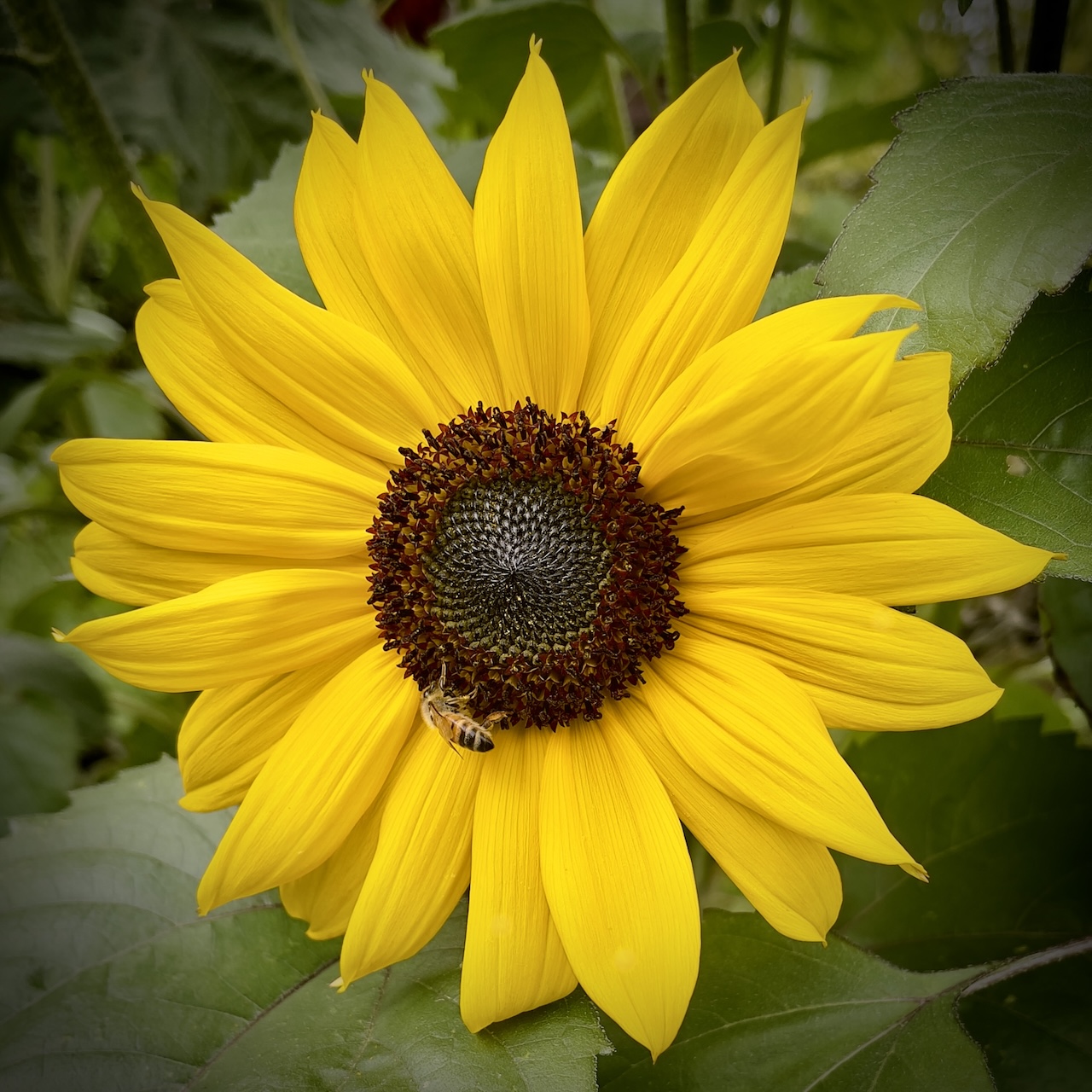
Researchers have found that natural patterns — especially fractals like those in tree branches, shells, and sunflower centers — can reduce stress by as much as 60%. Our brains process these repeating patterns with ease, which feels calming and restorative.
When we add the dynamic, living elements of nature — like a bee in motion — we’re gently pulled into presence. This unique blend of patterned coherence and gentle unpredictability is why nature helps us regulate more effectively than most indoor environments.
(Photo: A sunflower with a bee — fractal patterns meeting the dynamic life of nature.)
Small Doses: The Forest’s Wisdom on Healing
When it comes to grief and trauma, it’s tempting to think we have to face it all at once. But our systems can’t carry that kind of intensity. Healing works best in mini amounts — what somatic practitioners call titration.
Nature shows us this truth with perfect clarity. Trees don’t release every leaf in a single gust of wind. They let go gradually, a few at a time, until the forest floor is blanketed. Those leaves don’t disappear; they’re composted into fertile soil for the next season.

In the same way, we can release our pain little by little. A small cry, a gentle truth spoken aloud, a single memory honored and then set down. Each “leaf” we let fall is not wasted — it becomes part of the soil that nourishes who we’re becoming.
Not Just Big Things: Everyday Stresses Count Too
Nature connection isn’t only for the big, life-shaping traumas. It’s also a steady support for the everyday stresses that pull us out of safety. A walk after a difficult phone call, a pause to notice the sky between tasks, even a few breaths by an open window — these mini-connections help our systems reset so that the small upsets don’t snowball.

In fact, using nature for these small recalibrations builds nervous system resilience over time. The more we practice returning to safety in little moments, the easier it becomes to find our way back when life feels overwhelming.
Thoughts, Awareness, and Choice
Another gift of nature is perspective. When I’m outside, I notice not only the beauty around me but also the chatter in my mind. Sometimes those thoughts are supportive. Other times, they echo old gaslighting messages — the ones that insist I’m not enough, or that my needs don’t matter.
The difference is that in nature, I can observe these thoughts without immediately fusing with them. Like clouds passing across the sky, they move through. With awareness comes choice: Which thoughts will I water and grow? Which can I let drift away?
This awareness is key to moving from survival into thriving. When we know what’s moving through our system, we have more power to shift it.
Nature as One Tool in the Toolbox
Nature connection is a powerful practice, but it isn’t the only tool. When life feels unbearably heavy, reaching out for professional support can make all the difference. Therapy, coaching, community, or medical care can all be essential allies.
What’s wonderful is that nature connection integrates seamlessly with any healing path. Research shows that time in nature reduces rumination, lowers stress hormones, and supports emotional regulation — all of which can enhance the work we do in therapy or other modalities. Nature doesn’t compete with other forms of support; it strengthens them.
A Simple Practice to Try
You don’t need a forest or a mountain to begin. This practice can be done anywhere you find even a sliver of nature — a tree outside your window, a dandelion pushing through the sidewalk, a houseplant on your shelf.
- Pause and place a hand on your heart.
- Take three slow, grounding breaths. Feel your body supported by the ground beneath you.
- Notice three things in nature. A color, a shape, a sound, a movement. Let yourself linger with each one for a few breaths.
- Check in with your body. What do you feel? What shifts, even slightly, when you allow yourself this moment?
- Reflect gently. If a difficult thought arises, ask yourself: “Do I want to hold onto this, or can I let it fall like a leaf, to be composted into something new?”
It doesn’t take long. Even two minutes of presence like this can be a reset, a micro-dose of safety that begins to change how you move through the rest of your day.
From Survival Toward Thriving
Thriving isn’t about never feeling pain or never being triggered again. It’s about cultivating enough safety, enough awareness, and enough choice that we can live from our full selves rather than just our protective reflexes.
Nature offers us countless opportunities for this. Each sunrise, each breeze, each bird call is an invitation back into connection — with ourselves, with the world, and with life itself.
So if you find yourself stuck in survival mode, remember: you don’t have to do it all at once. Step outside. Notice one tree. Breathe. Release one leaf of grief at a time. Let the forest hold it, compost it, and show you that renewal is always possible.
Invitation
🍂 This autumn, I’m offering a brand-new Autumn Pocket Guide — a digital companion with weekly practices, reflections, and invitations to help you feel rooted and aligned with the season’s rhythm.
There’s also a live portion where we gather together in real time, practicing these tools side by side in community.
If you’re ready to move from survival toward thriving this season, I’d love for you to join me.
Because thriving isn’t something we achieve once and for all. It’s a daily choice — one breath, one step outside, one falling leaf at a time.

Curious what happens when you give yourself real permission to rest and heal? Read Coming Back to Yourself — The Gold in Authentic Self-Compassion, for a deeper dive.
